

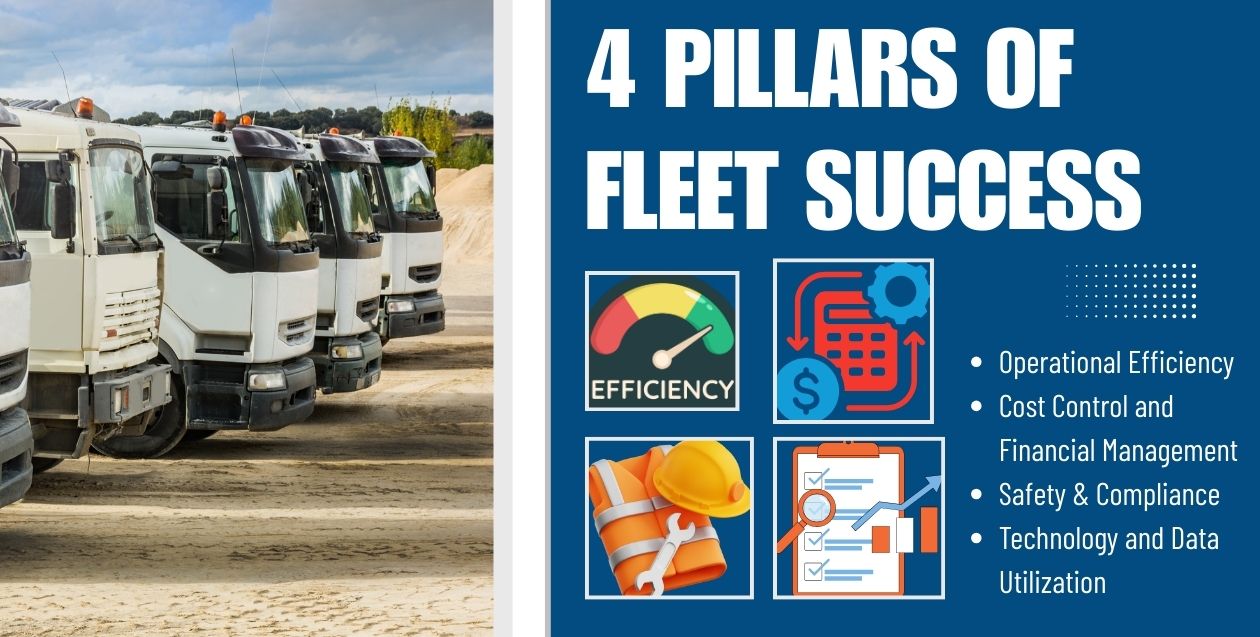
Managing today’s fleets (delivery vans, service oriented vehicles, equal heavy duty trucks) requires a lot more than simply keeping the vehicles up and running. Fleet management success should be evaluated on effectiveness and a combination of balancing performance, cost, safety and sustainability. Companies with successful fleet management typically employ four core principles that drive them toward sustainable and continued achievement in fleet management.
The operational efficiency of an organization is the backbone of a quality Fleet Management system. Within operational efficiency the emphasis is on the effective management of the vehicles, drivers and route scheduling utilizing the minimum amount of waste.
Operational efficiency encompasses:
An effective, operationally efficient fleet management operation will enable the organization to provide the highest level of customer service possible at the lowest possible operating expense, and increase their ability to meet the customer’s expectation.
Fleet Management systems require a large amount of capital investment and as a result, Cost Control is one of the four key principles of Fleet Management. A Fleet with Cost Control systems recognizes the costs associated with operating a fleet and actively monitors and takes action to manage and eliminate any costs associated with unnecessary use of capital. Fleet managers use the Fleet Service Management Pillars to improve the operation of their fleets by managing their costs and improving their ROI.
In the modern fleet, safety is a requirement – not an option. The implementation of a strong Safety Culture protects drivers and vehicles, while decreasing legal and financial risks to the company. Safety and compliance includes trainer and behavior monitoring for drivers. Compliance with regulations and industry-specific standards, accident prevention, and accident management. Fleets that focus on establishing a safety culture frequently have lower accident frequency, decreased insurance premiums, and higher driver retention and satisfaction.
The use of technology has become the primary method of determining success in the modern fleet. Utilizing data to assist in management decisions assists fleet managers with transitioning from a reactive approach to fleet management to a proactive approach to fleet management. The technology pillar includes many technologies including GPS, telematics, performance monitors or reports and maintenance software/tools. Proper data utilization results in improved visibility, increased accountability, improved trust and management decisions through the use of data.
Fleet success is not achieved through isolated improvements. It requires a systems-based approach where:
When these four pillars are aligned, fleets achieve higher uptime, lower costs, improved safety outcomes, and long-term operational resilience.
To be successful, fleets must have a well-balanced approach that encompasses more than just one focus area and includes all four components of a successful fleet operation. All elements, including safety, operational efficiency, technology, and cost control, need to work in concert with each other to provide a strong foundation for a fleet.
When fleets strengthen all four pillars of their operations, they can lower their risk and increase productivity, as well as better position their fleets for success in a competitive, technology-based world.

test